Nantong Yunju New material Technology Co., Ltd. is China Marble Cabinet Suppliers and Marble Cabinet Manufacturers, located in Haian, Jiangsu — the cradle of Jianghai Civilization. Established in 2021, the company specializes in the R&D, production, sales, and service of ultra-thin stone. As a modern innovative enterprise, it occupies a land area of 60 mu and is committed to delivering superior stone solutions to the market, supported by strong in-house R&D capabilities and advanced production techniques.
The company holds multiple invention and utility model patents, and has gathered an experienced team of technical and management professionals. The core team includes 6 specialized thin-stone technicians, 50 skilled workers, 5 quality control specialists, 6 production management staff, and 5 sales representatives, providing solid human resource support for product development, manufacturing, and end-to-end quality assurance.
Equipped with over 30 sets of specialized machinery, we have established a streamlined and efficient production process from raw blocks to finished products. Within just over two years of operation, our annual production capacity has reached approximately 300,000 square meters. We have become the designated stone supplier for more than 20 domestic and international furniture manufacturers. In addition, we have established stable partnerships with numerous design institutes and decoration companies, supplying high-quality ultra-thin stone and marble composite materials for a variety of key projects.

Marble Cabinet Suppliers
-
 Stone - Patterned Drawer Marble Cabinet
-
 Light Gray Marble Cabinet with Golden Edge
-
 Textured Decorative Marble Cabinet
-
 Glass - Inlaid Marble Cabinet
-
 Double - Drawer Patterned Marble Cabinet
-
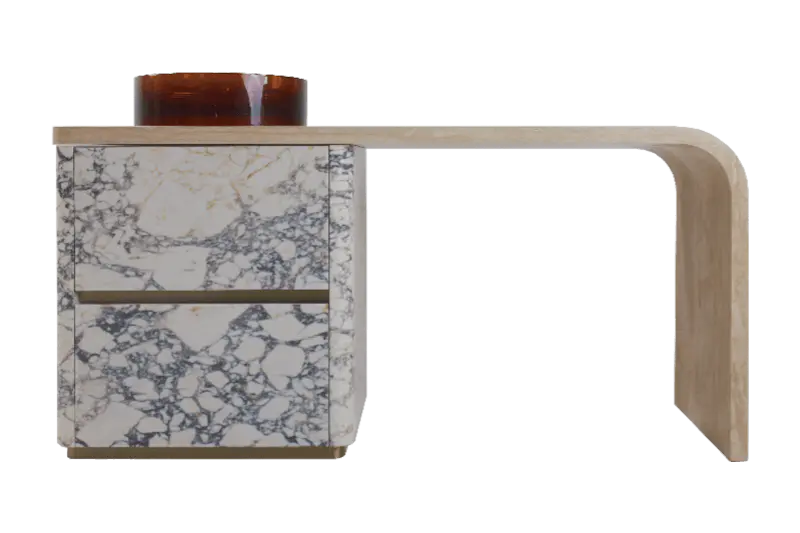 Special - Shaped Stone - Patterned Marble Side Cabinet
-
 Simple Gray - Toned Marble Cabinet
-
 Stone - Patterned Cylindrical Marble Cabinet
Marble Cabinet is a bathroom product that seamlessly blends high-end marble craftsmanship with modern home design. We utilize exquisite craftsmanship to create a wide range of marble sinks and cabinets, aiming to provide customers with bathroom spaces that are both functional and aesthetically pleasing. The natural veining and unique color of marble imbue each cabinet with a unique artistic quality, adding a luxurious touch to any bathroom while remaining exceptionally durable. The inherent smoothness and cleanliness of marble ensures easy cleaning of the sink and cabinet, preventing the accumulation of stains and water spots from daily use, keeping the bathroom pristine and looking pristine at all times. Our designs prioritize not only practicality but also meticulous attention to detail and aesthetic refinement, satisfying consumers' demands for both aesthetic and functional bathroom spaces.
Message Feedback
Company
Nantong Yunju New material Technology Co., Ltd.
News
-
Picture this: you walk into a stone showroom and run your hand over a polished marble tile. It looks elegant, but a dozen questions race through your mind. Will it scratch? Is it slippery? How much work is it to keep clean? Those are fair concerns. Marble floor tile can be a durable, long-lasting choice when you match...
READ MORE -
A marble dining table is one of the few pieces of furniture that changes character with the time of day. The same slab reads cool grey in the morning, warm cream under a pendant light, and almost metallic at night. That visual range is exactly why so many buyers choose by appearance alone, then discover six months lat...
READ MORE -
A marble console table usually occupies one of the most exposed positions in a home: the entryway wall, the end of a hallway, or the space behind a living room sofa. It is the first surface guests notice when they enter, and it carries everyday objects such as keys, mail, and decorative trays. Choosing the right one t...
READ MORE
Marble Cabinet Industry knowledge
Structural and Operational Comparison Between Modern Marble Cabinet Systems and Traditional Cabinet Materials
Dimensional Stability and Moisture Resistance Dynamics
Traditional cabinetry built from particleboard, medium-density fiberboard (MDF), or solid timber remains inherently vulnerable to environmental moisture fluctuations. In high-humidity zones like kitchens, bathrooms, and utility rooms, organic wood fibers absorb atmospheric water vapor, leading to core expansion, edge-band delamination, and surface warping over time. In contrast, a marble cabinet introduces a metamorphic rock surface that exhibits high dimensional stability under varying humidity levels. The crystalline calcium carbonate matrix does not swell or contract when exposed to ambient steam, preventing door alignment issues and carcass deformation that frequently affect timber-based storage units.
Recent technical refinements in ultra-thin stone manufacturing allow natural marble to be applied directly as cabinet door facings and side claddings without imposing prohibitive weight on hardware hinges. Engineering developments spearheaded by specialized materials developers—such as Nantong Yunju New Material Technology Co., Ltd. in Haian, Jiangsu—demonstrate how laminating 1mm to 3mm stone veneers onto composite cores creates moisture-impermeable door panels. This structural synthesis ensures that the outer shell of the marble cabinet resists humidity-induced decay, maintaining precise joinery gaps throughout its operational lifespan.
Surface Hardness and Mechanical Abrasion Endurance
Kitchen and bathroom cabinetry experiences continuous mechanical interaction, including contact with cookware, metallic utensils, cleaning tools, and personal care accessories. Conventional cabinet finishes—such as lacquered paints, thermofoil laminates, and wood veneers—possess limited surface hardness. Scratches, gouges, and impact dents on wood or laminate surfaces degrade protective coatings, exposing underlying cores to moisture ingress and accelerated wear. A marble cabinet offers a surface hardness derived from natural calcite minerals, providing inherent resistance to surface scratching and daily contact abrasion.
The wear resistance of natural stone extends to thermal tolerance. While thermofoil door edges peel when exposed to heat from adjacent oven ranges or steam appliances, natural stone facings remain thermally inert. Hot kitchenware placed temporarily against a stone cabinet surface will not scorch, blister, or melt the facing material, ensuring consistent surface integrity across high-heat domestic environments.
| Performance Parameter | Traditional Wood/MDF Cabinetry | Marble Cabinet Assembly |
|---|---|---|
| Base Material Composition | Organic cellulose fibers bonded with synthetic resin | Crystalline calcium carbonate backed by composite core |
| High Humidity Response | Vulnerable to core swelling, warping, and edge peeling | Dimensionally stable; non-swelling stone surface layer |
| Surface Heat Tolerance | Low to moderate; thermofoil melts and lacquer scorches | High thermal stability; resists heat blistering and scorching |
| Scratch Resistance Rating | Prone to dents, gouges, and surface coat abrasion | High mineral surface hardness resists everyday scratches |
| Long-Term Service Lifespan | Requires periodic refinishing or hardware realignment | Retains structural geometry and surface integrity over decades |
Weight Optimization Through Composite Lamination Engineering
Historically, integrating full-thickness stone slabs into storage furniture was impractical due to extreme mass loading. Solid 20mm marble panels create heavy dead loads that overload cabinet hinges, rack drawer slides, and strain wall-mounting brackets. The transition to ultra-thin stone composite panels resolves these mechanical weight constraints by separating surface aesthetics from structural load bearing. By bonding ultrathin marble slices to lightweight cores such as aluminum honeycomb or high-density glass fiber mesh, modern stone cabinets reduce front-panel mass by up to eighty percent compared to solid masonry.
This mass reduction expands the architectural versatility of the marble cabinet within modern interiors. Lightweight composite doors allow standard European-style concealed hinges and soft-close drawer slides to operate smoothly without suffering long-term sagging or alignment drift. Material fabricators like Nantong Yunju New Material Technology Co., Ltd. leverage in-house R&D capabilities across their 60 mu site to produce stabilized, lightweight stone veneers that permit full-height pantry doors, wall-hung vanities, and sliding island fronts to be covered in continuous natural stone without exceeding hardware weight thresholds.
Aesthetic Continuity and Geological Pattern Uniqueness
Mass-produced traditional cabinets rely on printed woodgrain overlays or synthetic solid colors to achieve visual uniformity across large kitchen layouts. While uniform, these artificial finishes lack depth and can appear repetitive across extended cabinet runs. A marble cabinet delivers distinct visual character through authentic mineral veining, calcite crystallization, and natural color variations inherent to quarried metamorphic rock. Each cabinet door or drawer front functions as an individualized visual element shaped by natural geological processes.
Furthermore, precision slicing techniques allow sequential thin stone sheets to be extracted consecutively from the same stone block section. By applying advanced book-matching and sequence-matching protocols—such as those developed within Nantong Yunju New Material Technology Co., Ltd.’s stone processing series—designers achieve continuous veining flow across adjacent marble cabinet doors. This grain continuity creates a unified visual surface across large kitchen islands, integrated appliance fronts, and bathroom vanity runs, delivering visual balance that synthetic laminates cannot replicate.
| Design & Manufacturing Factor | Traditional Synthetic/Timber Finish | Composite Marble Cabinet Facing |
|---|---|---|
| Surface Pattern Origin | Printed graphic overlay or uniform wood grain | Natural mineral veining and calcite crystallization |
| Visual Pattern Repeatability | High repetition across batch production runs | Unique surface pattern per individual sheet |
| Hinge & Hardware Compatibility | Standard concealed hinges and drawer slides | Standard hardware compatible via lightweight core design |
| Sealing & Stain Protection | Polyurethane, lacquer, or melamine seal | Vacuum polymer impregnation + topical stone sealer |
| Maintenance Protocol | Mild detergent wiping; avoid standing water | pH-neutral stone cleaner wiping; periodic sealer refresh |
Maintenance Requirements and Environmental Chemical Resistance
Long-term maintenance requirements differ significantly between organic wood composites and natural stone facings. Traditional timber cabinetry requires careful handling to avoid water pooling at joinery seams, which can cause substrate rot or mold growth behind sink bases. A marble cabinet features a dense, non-organic surface layer that inhibits mold proliferation and fungal growth in moist sanitary areas, making it suitable for high-grade bathroom vanities and kitchen waste modules.
To address natural stone porosity, modern ultra-thin stone sheets receive vacuum-pressure polymer resin impregnations during composite backing lamination. This factory process fills microscopic pores beneath the surface layer, inhibiting liquid absorption from household oils, coffee, and detergent spills. Combined with routine pH-neutral cleaning, the engineered marble cabinet preserves its smooth texture, color clarity, and structural joinery integrity across decades of continuous residential service.
FAQ
Q: How do lightweight composite technologies prevent marble cabinet doors from sagging or straining door hinges over time?
A: Traditional solid stone is far too heavy for standard cabinet hardware, causing door alignment to drift. Modern composite construction laminates an ultra-thin stone veneer to a lightweight core, such as aluminum honeycomb or high-density glass fiber. This reduces door panel mass by up to 80 percent, allowing standard European concealed hinges and soft-close drawer slides to operate smoothly without structural sagging.
Q: What measures are taken during lamination to ensure a marble cabinet withstands high humidity in kitchen and bathroom environments?
A: Unlike timber or MDF cabinets that swell and warp when exposed to ambient steam, natural stone faces are dimensionally stable. To enhance water resistance, technical processes—like those utilized in Nantong Yunju New Material Technology Co., Ltd.’s ultra-thin stone series—apply vacuum polymer resin impregnations during lamination. This seals microscopic pores, protecting internal composite layers and preventing moisture-induced delamination.
Q: How is continuous vein matching achieved across multiple doors on a large marble cabinet island or wall unit?
A: Precision mechanical slicing allows consecutive ultra-thin stone sheets to be extracted sequentially from the exact same quarried block section. Advanced processing methods enable fabricators to book-match or sequence-match adjacent veneer panels, creating unbroken mineral veining that flows seamlessly across consecutive cabinet doors and drawer fronts.
Q: Can the surface of a marble cabinet door handle direct exposure to heat from adjacent built-in ovens or steam appliances?
A: Yes. Natural metamorphic rock possesses high thermal tolerance and will not scorch, blister, or peel like thermofoil or lacquered wood finishes when exposed to hot kitchen environments. The thin stone face quickly dissipates thermal energy across its composite backing, maintaining surface stability near cooking appliances.
Q: How does the impact resistance of an ultra-thin stone cabinet panel compare to a traditional solid stone slab?
A: Solid stone slabs are naturally brittle and vulnerable to cracking along natural fault lines upon hard impact. Ultra-thin stone cabinet facings rely on high-tensile composite backings that act as energy absorbers. This multi-layer structure distributes localized impact forces, making the cabinet face far more resilient against accidental bumps from kitchenware or cookware.
Q: What maintenance routine is recommended to protect the polished finish of a marble cabinet from household oil and grease spills?
A: Daily care simply involves wiping the cabinet fronts with a soft microfiber cloth and a pH-neutral cleaner formulated for natural stone. Factory polymer impregnations and topical sealers prevent liquid oils and kitchen spills from penetrating the surface, eliminating the need for harsh chemical degreasers that could damage the stone's natural luster.
Q: How are outer corner seams handled on marble cabinet fronts to achieve a clean, solid stone appearance?
A: Fabricators employ 45-degree mitered edge-joining techniques, where the thin stone veneer is cut precisely and wrapped around the edges of the cabinet door core. By carefully aligning the stone grain at these mitered seams, the cabinet doors display the substantial look of solid masonry without adding unnecessary bulk or weight.
Yunju
Contact
-
 56 Ronggang Road, Binhai New Area, Laoba Port, Hai'an City, Nantong City, Jiangsu Province
-
 [email protected]
[email protected]

Mobile

Copyright ©Nantong Yunju New material Technology Co., Ltd.Rights Reserved.
 Custom Marble Cabinet Manufacturers