 English
 عربى
 Español
Picture a designer sending a request for a 2.4 m dining table in warm white marble, two matching si...
READ MORE
Marble Home Furnishings: A Practical Guide to Weight, Thickness and Build-Up
Content
A 2.4-metre dining table in white marble looks like a single decision on a mood board. On a specification sheet it is four: how heavy the top is, how the base carries that load, how the stone behaves at the edge, and how the joints line up where two slabs meet. Get any of them wrong and the most striking stone in the showroom becomes the piece you quietly stop using.
The short version: marble home furnishings should be chosen by build-up, not by swatch. Stone type sets the look and much of the cost, but thickness, substrate and edge detail decide whether a top stays flat after a year, whether a cabinet door still swings true, and whether a console survives being leaned on in a hallway. Below is how the categories differ, where the real risks sit, and which numbers belong in a purchase order.
What Marble Home Furnishings Actually Covers
The term is used loosely. In practice it splits into three families, and each behaves very differently once you start loading it.
- Marble home furnishings
- Tables
- Dining tables
- Coffee tables
- Console tables
- Side and corner tables
- Storage
- Cabinets
- Side cabinets and lowboards
- Seating
- Sofas
- Benches and chairs
- Tables
Tables are structural: a dining or coffee table is a free-standing frame with a stone top, and the design lives or dies on how that top is supported. Storage is different, because a cabinet is really a carcass with a stone skin, and the hardware — hinges, runners, anti-tip fixings — carries the load. Seating mixes stone with upholstery, so the questions shift to comfort, seat height and how the frame is fixed to the shell. The full marble home furnishings range shows how far the format stretches, from a compact 40 kg corner table to a three-metre console.
Weight and Thickness Come First
Most problems in marble furniture trace back to one number: kilograms per square metre. The comparison below uses common build-ups for the same nominal surface area.
Composite routes are less a compromise on appearance than a change of role: the stone becomes a surface rather than a structural element, which allows longer spans, slimmer profiles and much lower point loads on floors and on the base itself. The thinking behind those panels is set out in this look at marble composites, and the furniture consequence is simple — a 2.4 m top that needs a third support in 20 mm solid stone can often run unsupported in a composite build-up.
Edges are where weight can be won back. A 20 mm slab with a mitred 40 mm edge reads as a 40 mm top from across the room at roughly half the mass, and it removes the vulnerable chipped edge that worries most households. Tolerances matter just as much: ask for thickness tolerance (commonly ±0.5 mm), flatness (around 0.5 mm per running metre) and a consistent 1–2 mm joint gap. Without those figures written down, two pieces from the same range can arrive looking like they came from different workshops.
Dining Tables: The Base Carries the Design
On a dining table, the top is the part you see and the base is the part that decides whether you keep it. Four legs under a 2.4 m top leave a long unsupported middle; a single pedestal needs a foot plate wide enough to resist tipping when someone leans on the end. A workable rule of thumb is a base footprint of at least half the top's longest dimension.
Two details are worth asking about before ordering: support spacing under the top, roughly 700–800 mm between bearers for a 20 mm solid slab, and any tested deflection figures for rotating or double-layer designs, where the bearing hardware does the work and cannot be improvised.
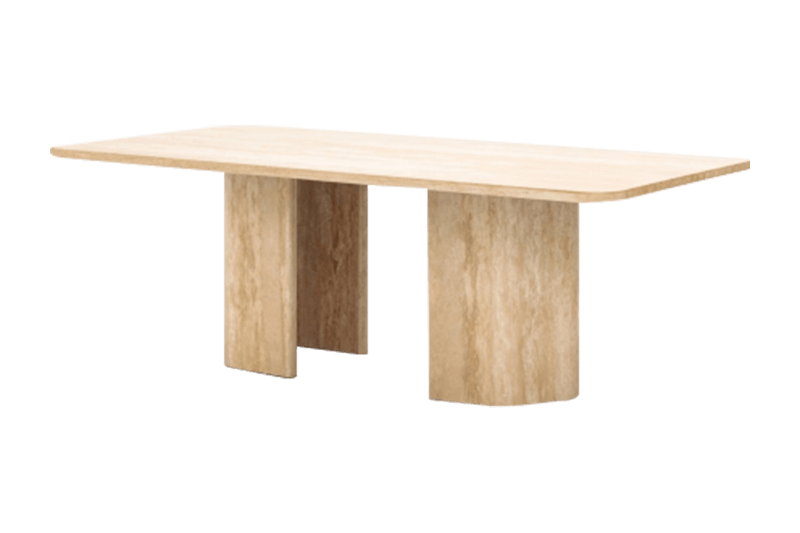
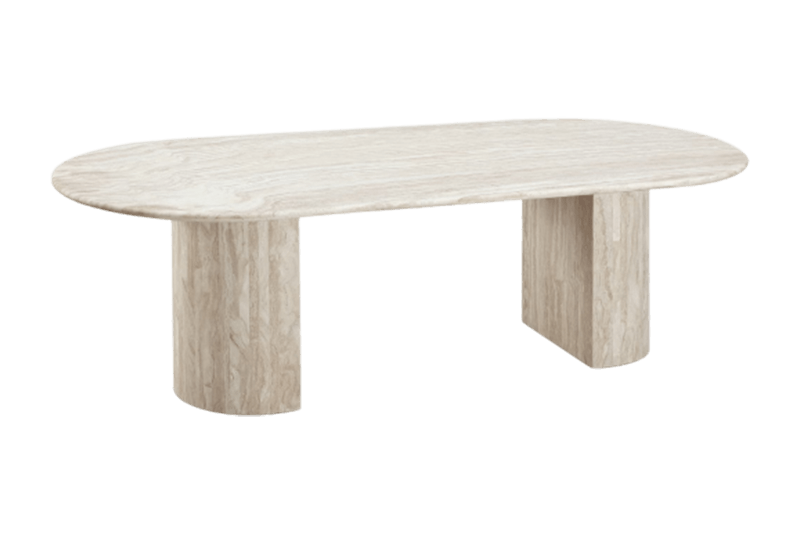
 Elegant Travertine Marble Dining Table with Dual-Column BaseA light beige travertine dining table with a dual-column base; check full-slab veining and support spacing before specifying the two-metre top.View Product →
Sample the stone at full size if you can. Veining that looks restrained on a 150 mm square can turn busy across a two-metre top, and book-matched pairs only work when both halves were cut from adjacent slabs.
Coffee Tables, Side Tables and Consoles
Living room pieces are smaller but less forgiving, because they sit at eye level and get moved. Coffee tables usually land between 350 and 450 mm high, side and corner tables around 500–600 mm, and consoles 750–850 mm so they sit comfortably against a wall.
Curved and faceted shapes are where fabrication quality shows. A double-curved table is a CNC job with joints that either align or do not, and a nesting set only works if the veining was planned across both pieces. Weight per piece runs from about 40 kg for a small corner table to well over 100 kg for a large organic coffee table, so felt pads and a two-person lifting plan are part of the purchase, not an afterthought.
 Bulgari Cloud Shadow Double Curved Marble Coffee TableA round marble coffee table with blue-white veining and a double-curved base; its curved fabrication and weight make joint alignment and lifting plans worth checking.View Product →
Consoles deserve their own warning. A 300–400 mm deep stone console is narrow, top-heavy and usually placed in a corridor where people brush past it. Wall anchoring should be specified as standard, not offered as an option.
Cabinets and Seating: Where Thin Stone Pays Off
Storage is where a thinner build-up earns its place. A 600 × 900 mm door in solid 20 mm stone weighs close to 30 kg, well beyond what a standard concealed hinge wants to carry. Bonding a thin stone skin to a lightweight frame brings the door back into a range the hardware can handle and helps the carcass stay square.
Ask about ratings rather than brand names: concealed hinges are usually comfortable with doors up to about 15–20 kg, and drawer runners are commonly rated between 30 and 50 kg. Tall cabinets should ship with anti-tip fixings, and anything holding stone above 1,200 mm should be anchored to the wall regardless of how stable it feels when empty.
 Double-Drawer Patterned Marble Bathroom Storage CabinetA patterned marble bathroom cabinet with double drawers and overhead lighting; for humid rooms, check runner ratings, anti-tip fixing and moisture-resistant construction.View Product →
Seating follows a different logic. Stone works as frame or shell, upholstery handles contact, and the numbers that matter are seat height (roughly 420–450 mm), the fixing between stone and shell, and whether the piece is light enough to move when the room changes.
A Short Specification Checklist
The points below are the ones worth putting in writing. They separate a piece that photographs well from one that still closes properly in five years.
| Item | What to specify | Why it matters |
|---|---|---|
| Build-up | 20 mm solid, or 10 mm skin on a honeycomb core | Sets weight, span limits and price more than the stone name does |
| Edge detail | Mitred 40 mm edge on a 20 mm slab | Visual thickness without the mass or the chipping risk |
| Tolerances | ±0.5 mm thickness, 0.5 mm/m flatness | Visible lippage at joints and misaligned cabinet doors |
| Joint gap | 1–2 mm, consistent across panels | Uneven gaps read as poor fabrication, whatever the stone cost |
| Fixing and stability | Wall anchors for consoles and tall cabinets | Heavy stone shifts the centre of gravity upward |
| Finish and sealing | Honed or polished, impregnating sealer | Staining resistance, especially on pale calcite stones |
Care That Matches the Material
Marble in furniture meets different hazards than a floor does: glasses, keys, hot mugs and the occasional moving box. A few habits keep it looking right.
- Wipe with a pH-neutral stone cleaner; skip vinegar, lemon, descaler and multi-surface sprays, which etch calcite-based stones.
- Blot spills rather than spreading them, particularly red wine, coffee and oil.
- Reseal honed or matte finishes every 12–18 months; polished surfaces usually hold longer between treatments.
- Use felt pads under every object and lift rather than drag, because a stone edge chips more easily than it scratches.
- Treat onyx and travertine as softer materials: onyx is often translucent and needs a backing panel, while travertine's filled holes can loosen under repeated point loads.
None of this makes marble furniture difficult to own. It makes it a specification exercise rather than a colour choice. Settle the build-up, thickness, edge and fixings first, and the stone you liked in the showroom will still be the stone you are living with in five years — just with fewer surprises attached.
PREV:No previous articleNEXT:Marble Home Customizer: How Thickness, Veining and Structure Decide the Piece
Interested in cooperation or have questions?
Related Products
-
 Elegant Travertine Marble Dining Table View More


-
 Chenghuaiya Stone Travertine Dining Table View More
-
 Elegant Cloud Shadow Travertine Dining Table View More
-
 Light and Shadow Travertine Dining Table View More
-
 Simple Dark Grey Stone Dining Table View More
-
 Gray Wood-Tone Marble Dining Table View More
-
 Off-White Gilded Marble Long Table View More
-
 EstéE Lauder Oval Marble Dining Table View More
-
 Rock Ash Cave Moon Mark Marble Rock Table View More
-
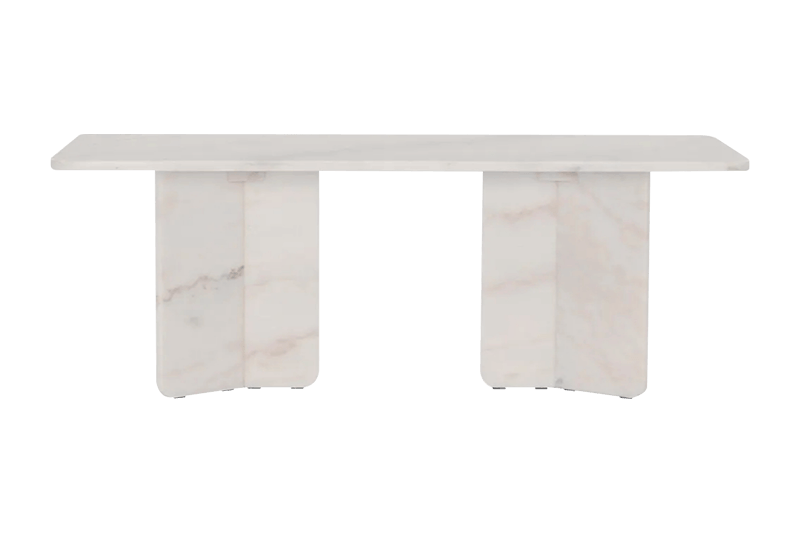 Elegant White and Refreshing Double-Pillar Marble Table View More
-
 Oval Marble Round Table with Large Floral and White Cloud Pattern View More
-
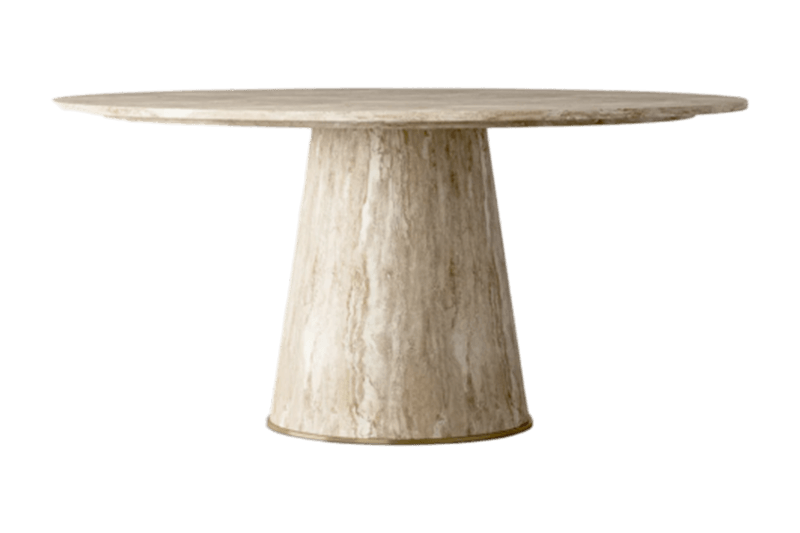 Simple Roman Hollow Marble Table View More
News
-
-
Price a marble wall panel for a hotel lift lobby and the figure that usually breaks the budget is n...
READ MORE -
Marble Home Furnishings including a natural marble bathtub, natural marble fireplace, and marble bat...
READ MORE -
Specifying a marble side table often begins with a simple question: will it feel solid or fragile w...
READ MORE -
When you compare marble home furnishings, start with construction rather than appearance. The most ...
READ MORE -
A marble dining table is one of the few pieces of furniture that changes character with the time of...
READ MORE
Yunju
Contact
-
 56 Ronggang Road, Binhai New Area, Laoba Port, Hai'an City, Nantong City, Jiangsu Province
-
 [email protected]

Mobile

Copyright ©Nantong Yunju New material Technology Co., Ltd.Rights Reserved.
 Custom Marble Composite Furniture Manufacturers